2011-07-19 "Story changing rapidly about South Seattle shooting, ‘person of interest’" by Dave Workman, Seattle Gun Rights Examiner
[http://www.examiner.com/gun-rights-in-seattle/story-changing-rapidly-about-south-seattle-shooting-person-of-interest]
Faster than one can crank out a newspaper, the details surrounding the fatal shooting of a so-called “person of interest” in a South Seattle homicide by San Francisco police over the weekend are changing, leaving one to ponder whether the dead man, Kenneth Wade Harding, had any connection to the slaying of Tanaya Gilbert last week.
The Seattle Times [http://seattletimes.nwsource.com/html/localnews/2015648781_shooting19m.html], on-line Seattle Post-Intelligencer [http://www.seattlepi.com/local/article/SF-police-Deceased-shooter-s-gun-was-taken-from-1471744.php] (picking up a story from the San Francisco Chronicle), KIRO 7 Eyewitness News and a news blog on the KQED website reveal some startling new details about the Gilbert slaying and the subsequent killing of Harding hundreds of miles away in a different state.
Among the more significant was this:
"Gilbert was a former Renton High School student who turned 19 a week ago, family members said. Relatives believed that Gilbert was seven weeks pregnant. But the King County Medical Examiner's office told Gilbert's mother her daughter wasn't..."—Seattle Times
Another twist in the case appears in the Chronicle story picked up this morning by the Post-Intelligencer:
"A pistol that San Francisco police believe Kenneth Wade Harding may have used before being shot to death here Saturday was found at another location. But police in San Francisco says it is a different caliber from the one used to kill 19-year-old Tanaya Gilbert a week ago in Seattle."—San Francisco Chronicle
When this column spoke yesterday with Seattle police, they made no official connection between the two incidents, and would not even confirm whether San Francisco investigators were talking to police detectives here. That has changed, with this morning’s Seattle Times report that detectives here are “working on the investigation with San Francisco police…”
Every published report has Harding running from a pair of police officers who were checking for fare violations on a rapid transit platform. Law enforcement sources not involved in either investigation immediately raised some questions: Why would Harding, who reportedly was in violation of his parole here earlier this year by being in California, suddenly run from the police over an apparent transit fare evasion? Why would he open fire on the police, as alleged?
Was he fearful of being arrested for being a felon in possession of a gun?
Or was there another reason?
Why was he in California at all? Had he fled there for some reason?
For the record, as the Seattle Times is reporting this morning:
"No evidence has been disclosed by law-enforcement officials that directly links Harding to the Seattle shootings."
This all must be sorted out, but what is known is that at age 19, Harding had already spent time in prison, serving a year at the Clallam Bay Corrections Center for “attempted promoting of commercial sexual abuse” of a young teenage girl. Clallam Bay is the same facility from which Tacoma Mall shooter Dominick Maldonado recently tried to escape, as this column reported [http://www.examiner.com/gun-rights-in-seattle/did-tacoma-mall-gunman-cheat-death-again-prison-break-attempt].
KIRO is reporting that:
"Harding met with his community corrections officer at 1 p.m. on Wednesday, 10 hours before a gunman fired on a group of teenagers in South Seattle, killing 19-year-old Tanaya Gilbert and wounding three others."—KIRO 7 Eyewitness News
And as this column noted yesterday [http://www.examiner.com/gun-rights-in-seattle/in-seattle-they-re-thanking-the-san-francisco-police-for-good-marksmanship], the gun allegedly carried by Harding during the shootout in San Francisco was grabbed by someone at the scene. Police later recovered it thanks to an informant. Now the San Francisco Chronicle and Post-Intelligencer report that somebody even grabbed all but one of the spent shell casings from the San Francisco shooting scene.
One can make a couple of presumptions about that. Either the crowd wanted keepsakes, or somebody was trying to make this look like the shooting of an unarmed man. That’s tampering with evidence, and it is a crime everywhere.
This story is far from an ending, and it already is assured the ending will not be happy.
Tuesday, July 19, 2011

2011-07-19 "West Sac Police takes camera and arrests eyewitness who now faces deportation"
[http://www.indybay.org/newsitems/2011/07/19/18685280.php]
West Sacramento police have arrested an eyewitness to police brutality and took his camera. The eyewitness, Jesus Castro, now faces deportation and is currently in jail. A protest is planned for July 20th.
On Sunday July 17th, West Sacramento resident Jesus Castro was arrested and had his camera confiscated by West Sacramento police while videotaping an incident of police brutality. Mr. Castro, who is undocumented, now faces deportation and is currently being held at Yolo County Jail. This follows a pattern of police brutality and discrimination in Yolo County, especially in West Sacramento, where the Latino community has been under siege for several years. This includes so-called gang injunction, which specifically targets Latino youth, forbidding them from dressing in certain colors that the short-sighted authorities believes identifies them as gang members, as well as depriving them of their freedom of association.
In response to this new attack, the community is not standing idle. Two local groups are organizing a peaceful protest on Wednesday, July 20th at 6pm outside West Sacramento City Hall (1110 West Capitol Avenue).
For more information on the protest and the incident, contact:
Frank Gonzalez (LULAC) at 916-821-6823
Paramo Hernandez (Primero de Mayo) at 916-825-0402
[http://www.indybay.org/newsitems/2011/07/19/18685280.php]
West Sacramento police have arrested an eyewitness to police brutality and took his camera. The eyewitness, Jesus Castro, now faces deportation and is currently in jail. A protest is planned for July 20th.
On Sunday July 17th, West Sacramento resident Jesus Castro was arrested and had his camera confiscated by West Sacramento police while videotaping an incident of police brutality. Mr. Castro, who is undocumented, now faces deportation and is currently being held at Yolo County Jail. This follows a pattern of police brutality and discrimination in Yolo County, especially in West Sacramento, where the Latino community has been under siege for several years. This includes so-called gang injunction, which specifically targets Latino youth, forbidding them from dressing in certain colors that the short-sighted authorities believes identifies them as gang members, as well as depriving them of their freedom of association.
In response to this new attack, the community is not standing idle. Two local groups are organizing a peaceful protest on Wednesday, July 20th at 6pm outside West Sacramento City Hall (1110 West Capitol Avenue).
For more information on the protest and the incident, contact:
Frank Gonzalez (LULAC) at 916-821-6823
Paramo Hernandez (Primero de Mayo) at 916-825-0402
Sunday, July 17, 2011
2011-07-17 "‘Why should you die for a transfer?’" by Willie Ratcliff from "San Francisco Bayview Newspaper"
[http://sfbayview.com/2011/why-should-you-die-for-a-transfer/]
Bay View publisher Willie Ratcliff can be reached at publisher@sfbayview.com or (415) 671-0789.
---
Sister Halimah Allah writes from Los Angeles on July 18: “As I watch another Black man – shot down in the street like a mad dog by occupation forces paid for by our tax dollars and 456 years of dehumanization – I read accounts of the incident and wonder: What is this young man’s name? Who are his people: family, friends etc.? Does he have a mother? Does she know her son is dead? (Peace be upon him.) I’m the mother of four Black men! I’m grandma to nine grandsons. I’m great-grandma to one. I’ve seen this scene too many times in my 70 years! I wonder: WHO WILL MOURN for this young Black Man? WHO WILL MOURN for all those yet to fall at the hands of our ever-open enemies? Who will mourn for us all?”
When police stopped a teenager stepping off the T-train yesterday to show his transfer as proof he’d paid his fare – $2 at most – he ran from them. They shot him as many as 10 times in the back and neck, according to witnesses. For many long minutes, as a crowd watched in horror, the boy, who had fallen to the sidewalk a block away, lay in a quickly growing pool of blood writhing in pain and trying to lift himself up as the cops trained their guns on him and threatened bystanders.
Having killed the boy at 4:44 p.m., according to the San Francisco Chronicle [http://www.sfgate.com/cgi-bin/article.cgi?f=/c/a/2011/07/17/MNVU1KBGHI.DTL], in broad daylight at the main intersection – Third Street between Palou and Oakdale – in Bayview Hunters Point, San Francisco’s last largely Black neighborhood, the police seemed eager to terrorize the community. They waited and waited and waited as the teenager stopped moving but continued breathing before eventually setting him on a gurney and taking him to the hospital, where the Chronicle reports he died at 7:01 p.m.
“Why should you die for a transfer?” asked a witness known as Tiptoe in the crowd of hundreds of residents that soon gathered in the plaza at the Oakdale/Palou light rail stop. “Justice will be brought!” hollered one man repeatedly in a booming voice as the crowd shouted at the long line of police in riot gear standing between them and the dying youngster. “I saw the riot squad fly by me on Palou yesterday – five trucks in all,” wrote Bayview resident Sherry Bryson on Facebook.
As usual following police murders, the San Francisco Police Department came up with an excuse. The Chronicle relayed it: “As the officers tried to detain the man, he took off running and drew a gun, police said,” according to staff writer Joe Garofoli. “When the suspect shot at the officers, they returned fire, fatally wounding him,” he continued, quoting SFPD Sgt. Michael Andraychak.
None of the many witnesses I spoke with yesterday saw the young victim either holding or shooting a gun and firmly believe he was unarmed. ABC7’s Carolyn Tyler balanced the police claim that they shot the youngster in self-defense by interviewing Trivon Dixon, who said: “He was running. How could he be a threat in retreat? And he wasn’t running backwards, turning around shooting. He was in full throttle, running away from the police. I don’t see in any way how he could be a threat to the police.”
On Sunday, KTVU.com reported an announcement by San Francisco Police Chief Greg Suhr that a gun had been found which he said belonged to the victim [http://www.ktvu.com/news/28578277/detail.html]. That police have also kicked off the usual campaign to demonize the victim is evident in KTVU noting that “the suspect had an extensive criminal record out of state.” And in another standard response to a police murder, KTVU reported, “Police patrolled the Third Street corridor Sunday with an additional 10 officers due to an increase in gun violence in the past three weeks.”
“How come a Black man can get shot for not having a transfer? How come a Black man has to be so terrorized that he feels that he has to run for not having a transfer?” ponders activist and graduate student Malaika Kambon. “These kinds of killings have not, would not, do not ever happen in white communities anywhere in the world,” she notes in a Facebook discussion.
“This is insane! They are shooting people over transfers?” exclaimed Renaldo Ricketts on Facebook. “Over a transfer – a piece of paper? That is just so wrong!” wrote Sherry Bryson.
“Why did they have to chase him for a transfer?” wrote Latashia Burleson, who started the discussion. “There are many people on the bus who didn’t pay. What they gone do, chase everyone down? And they wonder why they don’t get no respect or cooperation in the community. This makes my blood boil. It has to stop!”
On June 29, Bayview- and Mission District-based POWER, heading a coalition of transit and civil right activist groups that recently helped secure 12,000 free passes for low-income youth passengers, staged a demonstration calling for free Muni – free transit passes for all passengers, the San Francisco Examiner reported [http://www.sfexaminer.com/blogs/under-dome/2011/06/san-francisco-group-wants-free-muni-agency-says-would-cost-least-190-millio]. The San Francisco Municipal Railway, known as Muni, has followed up major rate increases in recent years with greatly intensified police fare enforcement, imposing heavy fines and even jail time for riders who are unable to prove by showing a paper transfer that they paid their fare.
“Let’s all remember that we are second class citizens to the police. Period,” remarked Robert Pineda.
“We have a Mafioso-type situation in San Francisco,” wrote Alan Collins, “where the police make endorsements of so-called ‘moderate’ political candidates and those candidates very often win election and you almost never hear anything from them that amounts to criticism, let alone any type of serious investigation, of the police. This has made SF a city with police who are simply unaccountable, can be assured of getting away with virtually anything, and a collection of elected officials who know that if they do anything that counters what the police want, they will be treated the way Rupert Murdoch has operated with his media empire: reward and punishment.”
“As the state has removed any illusion that it exists to serve or protect people, we can see clearly that it exists only to push us into prisons and to shoot us in cold blood. Two single dollars are worth more to them than our lives. The very existence of the police clearly endangers all of us,” concluded an anonymous writer on Indybay.
A comment on YouTube under the video, “SFPD Ruthlessly Shoots and Kills Unarmed 19yr old Man over $2 Bus Fair,” posted above, reflects the common wisdom in the community that this was a public execution with a purpose: “The white man did the same thing during slavery. They would take a Black man and whip him or kill him in front of all the slaves, to make sure the slaves got the picture of who’s in control.”
A press conference and speakout has been called for Monday noon at Third and Oakdale by the Idriss Stelley Foundation, Education Not Incarceration, the San Francisco Bay View newspaper and Poor Magazine. According to Indymedia, a protest will begin at 5 p.m. Tuesday in Dolores Park.
This frame from a video shot by a bystander shows the teenager struggling to lift himself out of a pool of his own blood as a San Francisco police officer – one of several – aims his gun at the boy rather than trying to save his life. – Video frame: TheOneNonly457
 As night fell, firefighters washed the teenager's blood off the sidewalk and police and reporters talked. Rick Hauptman, who posted this photo on Facebook, noted: "The police seemed almost jolly. I saw many handshakes among them; I couldn't figure that out. Were they solely being respectful to their colleagues and to senior officers, or was it something else?”

[http://sfbayview.com/2011/why-should-you-die-for-a-transfer/]
Bay View publisher Willie Ratcliff can be reached at publisher@sfbayview.com or (415) 671-0789.
---
Sister Halimah Allah writes from Los Angeles on July 18: “As I watch another Black man – shot down in the street like a mad dog by occupation forces paid for by our tax dollars and 456 years of dehumanization – I read accounts of the incident and wonder: What is this young man’s name? Who are his people: family, friends etc.? Does he have a mother? Does she know her son is dead? (Peace be upon him.) I’m the mother of four Black men! I’m grandma to nine grandsons. I’m great-grandma to one. I’ve seen this scene too many times in my 70 years! I wonder: WHO WILL MOURN for this young Black Man? WHO WILL MOURN for all those yet to fall at the hands of our ever-open enemies? Who will mourn for us all?”
When police stopped a teenager stepping off the T-train yesterday to show his transfer as proof he’d paid his fare – $2 at most – he ran from them. They shot him as many as 10 times in the back and neck, according to witnesses. For many long minutes, as a crowd watched in horror, the boy, who had fallen to the sidewalk a block away, lay in a quickly growing pool of blood writhing in pain and trying to lift himself up as the cops trained their guns on him and threatened bystanders.
Having killed the boy at 4:44 p.m., according to the San Francisco Chronicle [http://www.sfgate.com/cgi-bin/article.cgi?f=/c/a/2011/07/17/MNVU1KBGHI.DTL], in broad daylight at the main intersection – Third Street between Palou and Oakdale – in Bayview Hunters Point, San Francisco’s last largely Black neighborhood, the police seemed eager to terrorize the community. They waited and waited and waited as the teenager stopped moving but continued breathing before eventually setting him on a gurney and taking him to the hospital, where the Chronicle reports he died at 7:01 p.m.
“Why should you die for a transfer?” asked a witness known as Tiptoe in the crowd of hundreds of residents that soon gathered in the plaza at the Oakdale/Palou light rail stop. “Justice will be brought!” hollered one man repeatedly in a booming voice as the crowd shouted at the long line of police in riot gear standing between them and the dying youngster. “I saw the riot squad fly by me on Palou yesterday – five trucks in all,” wrote Bayview resident Sherry Bryson on Facebook.
As usual following police murders, the San Francisco Police Department came up with an excuse. The Chronicle relayed it: “As the officers tried to detain the man, he took off running and drew a gun, police said,” according to staff writer Joe Garofoli. “When the suspect shot at the officers, they returned fire, fatally wounding him,” he continued, quoting SFPD Sgt. Michael Andraychak.
None of the many witnesses I spoke with yesterday saw the young victim either holding or shooting a gun and firmly believe he was unarmed. ABC7’s Carolyn Tyler balanced the police claim that they shot the youngster in self-defense by interviewing Trivon Dixon, who said: “He was running. How could he be a threat in retreat? And he wasn’t running backwards, turning around shooting. He was in full throttle, running away from the police. I don’t see in any way how he could be a threat to the police.”
On Sunday, KTVU.com reported an announcement by San Francisco Police Chief Greg Suhr that a gun had been found which he said belonged to the victim [http://www.ktvu.com/news/28578277/detail.html]. That police have also kicked off the usual campaign to demonize the victim is evident in KTVU noting that “the suspect had an extensive criminal record out of state.” And in another standard response to a police murder, KTVU reported, “Police patrolled the Third Street corridor Sunday with an additional 10 officers due to an increase in gun violence in the past three weeks.”
“How come a Black man can get shot for not having a transfer? How come a Black man has to be so terrorized that he feels that he has to run for not having a transfer?” ponders activist and graduate student Malaika Kambon. “These kinds of killings have not, would not, do not ever happen in white communities anywhere in the world,” she notes in a Facebook discussion.
“This is insane! They are shooting people over transfers?” exclaimed Renaldo Ricketts on Facebook. “Over a transfer – a piece of paper? That is just so wrong!” wrote Sherry Bryson.
“Why did they have to chase him for a transfer?” wrote Latashia Burleson, who started the discussion. “There are many people on the bus who didn’t pay. What they gone do, chase everyone down? And they wonder why they don’t get no respect or cooperation in the community. This makes my blood boil. It has to stop!”
On June 29, Bayview- and Mission District-based POWER, heading a coalition of transit and civil right activist groups that recently helped secure 12,000 free passes for low-income youth passengers, staged a demonstration calling for free Muni – free transit passes for all passengers, the San Francisco Examiner reported [http://www.sfexaminer.com/blogs/under-dome/2011/06/san-francisco-group-wants-free-muni-agency-says-would-cost-least-190-millio]. The San Francisco Municipal Railway, known as Muni, has followed up major rate increases in recent years with greatly intensified police fare enforcement, imposing heavy fines and even jail time for riders who are unable to prove by showing a paper transfer that they paid their fare.
“Let’s all remember that we are second class citizens to the police. Period,” remarked Robert Pineda.
“We have a Mafioso-type situation in San Francisco,” wrote Alan Collins, “where the police make endorsements of so-called ‘moderate’ political candidates and those candidates very often win election and you almost never hear anything from them that amounts to criticism, let alone any type of serious investigation, of the police. This has made SF a city with police who are simply unaccountable, can be assured of getting away with virtually anything, and a collection of elected officials who know that if they do anything that counters what the police want, they will be treated the way Rupert Murdoch has operated with his media empire: reward and punishment.”
“As the state has removed any illusion that it exists to serve or protect people, we can see clearly that it exists only to push us into prisons and to shoot us in cold blood. Two single dollars are worth more to them than our lives. The very existence of the police clearly endangers all of us,” concluded an anonymous writer on Indybay.
A comment on YouTube under the video, “SFPD Ruthlessly Shoots and Kills Unarmed 19yr old Man over $2 Bus Fair,” posted above, reflects the common wisdom in the community that this was a public execution with a purpose: “The white man did the same thing during slavery. They would take a Black man and whip him or kill him in front of all the slaves, to make sure the slaves got the picture of who’s in control.”
A press conference and speakout has been called for Monday noon at Third and Oakdale by the Idriss Stelley Foundation, Education Not Incarceration, the San Francisco Bay View newspaper and Poor Magazine. According to Indymedia, a protest will begin at 5 p.m. Tuesday in Dolores Park.
This frame from a video shot by a bystander shows the teenager struggling to lift himself out of a pool of his own blood as a San Francisco police officer – one of several – aims his gun at the boy rather than trying to save his life. – Video frame: TheOneNonly457
 As night fell, firefighters washed the teenager's blood off the sidewalk and police and reporters talked. Rick Hauptman, who posted this photo on Facebook, noted: "The police seemed almost jolly. I saw many handshakes among them; I couldn't figure that out. Were they solely being respectful to their colleagues and to senior officers, or was it something else?”
Saturday, July 16, 2011
2011-07-16 "Oscar Grant's best friend is shot, killed" by Henry K. Lee from "San Francisco Chronicle" newspaper
[http://www.sfgate.com/cgi-bin/article.cgi?f=%2Fc%2Fa%2F2011%2F07%2F16%2FBAB31KBCN2.DTL&tsp=1]
The best friend of Oscar Grant who was there the night a BART police officer fatally shot the unarmed man was shot and killed at a Hayward gas station, authorities and friends said Saturday.
Johntue Caldwell, 25, of Fremont was found behind the wheel of a Cadillac parked at the Union 76 gas station at West Tennyson Road and Calaroga Avenue about 5:35 p.m. Friday, according to police and friends.
The victim had been sitting in the Cadillac when someone walked up to the vehicle and fired several rounds, said Hayward police Lt. Roger Keener. The assailant fled and was not located after a search of the area.
The motive for the slaying was not known, but police do not believe this was a random act, Keener said.
"Investigators will be focusing on learning anything they can about this incident from people who may have been in the area at the time," Keener said. "Through their investigation, they also expect to determine if the victim was the intended target of this attack."
In 2010, Caldwell filed a $5 million federal civil rights lawsuit, saying he was mistreated by a second BART police officer, Marysol Domenici, before Officer Johannes Mehserle shot Grant in the back on the platform of Oakland's Fruitvale Station early Jan. 1, 2009. Mehserle was recently released from custody after serving half of a two-year prison term for involuntary manslaughter.
Caldwell, the father of two young sons, was the godfather of Grant's daughter, Tatiana, now 7, who received a $1.5 million settlement from BART in connection with Grant's death.
Caldwell's suit, which is still pending, said Domenici ordered him to the ground, threatened him with a Taser, touched the stun gun to his face and cursed him using a racial slur. Caldwell was "mentally and emotionally injured," his attorneys wrote.
Dale Allen, an attorney for BART, said after the suit was filed that Caldwell had a "significant criminal history" and was one of three men who cursed at and physically challenged officers as they detained Grant and three others after a fight on a train.
But John Burris, an attorney for Grant's family whose civil suit against BART officers is pending, said Saturday, "Nothing I know about Johntue says that he was involved in any illegal activity."
Burris said, "Johntue was a wonderful young man. He had career objectives. He and his mother were very, very close. He and Oscar had been friends since early childhood. They were as close as brothers could be, and this is a tragedy of the highest order. It's hard to imagine that another young man of that relatively small group of people is dead."

"Uhuru Solidarity of Oakland" wrote:
No matter how you look at it, this is a terroristic system we live in.
Johntue Caldwell was on the platform with Oscar Grant.
He had a lawsuit pending.
They try to say he had a criminal record but it is this system that has a criminal record for killing African people.
Vigil for Jontue Caldwell, tonight, 6pm, July 16, 2011
West Tennyson Road & Calaroga Ave., Hayward, CA

[http://www.sfgate.com/cgi-bin/article.cgi?f=%2Fc%2Fa%2F2011%2F07%2F16%2FBAB31KBCN2.DTL&tsp=1]
The best friend of Oscar Grant who was there the night a BART police officer fatally shot the unarmed man was shot and killed at a Hayward gas station, authorities and friends said Saturday.
Johntue Caldwell, 25, of Fremont was found behind the wheel of a Cadillac parked at the Union 76 gas station at West Tennyson Road and Calaroga Avenue about 5:35 p.m. Friday, according to police and friends.
The victim had been sitting in the Cadillac when someone walked up to the vehicle and fired several rounds, said Hayward police Lt. Roger Keener. The assailant fled and was not located after a search of the area.
The motive for the slaying was not known, but police do not believe this was a random act, Keener said.
"Investigators will be focusing on learning anything they can about this incident from people who may have been in the area at the time," Keener said. "Through their investigation, they also expect to determine if the victim was the intended target of this attack."
In 2010, Caldwell filed a $5 million federal civil rights lawsuit, saying he was mistreated by a second BART police officer, Marysol Domenici, before Officer Johannes Mehserle shot Grant in the back on the platform of Oakland's Fruitvale Station early Jan. 1, 2009. Mehserle was recently released from custody after serving half of a two-year prison term for involuntary manslaughter.
Caldwell, the father of two young sons, was the godfather of Grant's daughter, Tatiana, now 7, who received a $1.5 million settlement from BART in connection with Grant's death.
Caldwell's suit, which is still pending, said Domenici ordered him to the ground, threatened him with a Taser, touched the stun gun to his face and cursed him using a racial slur. Caldwell was "mentally and emotionally injured," his attorneys wrote.
Dale Allen, an attorney for BART, said after the suit was filed that Caldwell had a "significant criminal history" and was one of three men who cursed at and physically challenged officers as they detained Grant and three others after a fight on a train.
But John Burris, an attorney for Grant's family whose civil suit against BART officers is pending, said Saturday, "Nothing I know about Johntue says that he was involved in any illegal activity."
Burris said, "Johntue was a wonderful young man. He had career objectives. He and his mother were very, very close. He and Oscar had been friends since early childhood. They were as close as brothers could be, and this is a tragedy of the highest order. It's hard to imagine that another young man of that relatively small group of people is dead."
Johntue Caldwell

"Uhuru Solidarity of Oakland" wrote:
No matter how you look at it, this is a terroristic system we live in.
Johntue Caldwell was on the platform with Oscar Grant.
He had a lawsuit pending.
They try to say he had a criminal record but it is this system that has a criminal record for killing African people.
Vigil for Jontue Caldwell, tonight, 6pm, July 16, 2011
West Tennyson Road & Calaroga Ave., Hayward, CA

2011-07-16 "A New Era in Policing?"
[http://surfcityrevolt.blogspot.com/2011/07/new-era-in-policing.html]
News of "Predictive Policing" first surfaced around the new year. Hailed as the next generation of policing, it seeks to direct police resources to "times and places" where there is a greater likelihood of crime being committed. Sometime in January, the Santa Cruz Police Department finished submitting crime reports from the last eight years to George Mohler [http://math.scu.edu/~gmohler/homepage.html], a mathematics professor at Santa Clara University. Santa Cruz is the first city in the nation to embrace this model. In Mohler's own words: "The more you put police in areas where there is more crime, the more efficiently you're policing the city." The Sentinel article about SCPD's adoption of the program can be found here [http://www.santacruzsentinel.com/ci_17105195]. In this article, rather than rehashing what has already been said, we will emphasize the unstated significance of predictive policing and point towards ways to frustrate, antagonize, or just operate within a town that will try to predict your crime before you commit it.
New Smell, Same Shit -
Since at least some future police reports will be a product of predictive policing, while the analytics that power predictive policing are fed by prior police reports, it is likely that the predictive policing will create reinforcing feedback loops [http://en.wikipedia.org/wiki/Positive_feedback]. As predictive policing recognizes a concentration of criminal activity, it will direct police resources towards that concentration. The concentration can be geographical, like the Bonesio's Parking Lot, and also have a temporal dimension, like closing time. By directing police patrols towards these locations, the police can harass, detain, or arrest people more efficiently. Their actions result in police reports that get funneled back into the predictive policing analytics, further concentrating crime in these already targeted areas.
By targeting places where crime is already reported, predictive policing increases social division: bad neighborhoods are further ghettoized, while pressure it taken off good neighborhoods. Kids in the upper westside take "d-methamphetamine" (marketed as Deoxsyn for ADHD) to get high and feel good, while those trapped in desperate circumstances smoke dirty crystal for the same reasons. One group is mostly ignored by police, while the other is criminalized. Predictive policing further concentrates police pressure on the more targeted group. This is not to say that the ideal solution is some equitable form of policing, only that existing social divisions are further sharpened by this program.
At least some of the inspiration for predictive policing comes from the success of computer analytics in determining the actions of consumers. As Police Chief Magazine reports [http://www.policechiefmagazine.org/magazine/index.cfm?fuseaction=display_arch&article_id=1942&issue_id=112009]:
[begin excerpt]
Advanced analytics are used in almost every segment of society to improve service and optimize resources. Some examples include customer loyalty programs that track purchases and provide specifically targeted coupons that are based on recent or related purchases and algorithms that create models of customer preferences and recommend products to similar customer groups.
[end excerpt]
In every corner of our lives, data is being collected about us and our actions. These data storehouses have been utilized to sell us consumer goods tailored to our specific tastes. Now, these databases are becoming fodder for the predictive policing analytics. In a Department of Justice bulletin on Community-Oriented Policing [http://www.nij.gov/nij/maps/gps-bulletin-v2i4.pdf], the first "tool" listed in a "predictive policing toolbox" was to: "Identify data from other agencies (e.g., schools and hospitals) that may be useful for predictive policing analyses". Predictive Policing might be the bridge between the warehousing of personal and relational data and the always-tightening clampdown of social control. Advanced analytics, of course, have always been part of the police toolkit, but until now they have been reserved for large operations, usually run by federal agencies. Now, the same techniques are becoming available at local levels.
As these techniques trickle down to local agencies, coupled with Jerry Brown's restructuring towards local government, police are realizing that "community" initiatives are of increasing importance. If the police are going to be on your block constantly, they want to do it with a smiling face. Put differently, they want to avoid being a target for the antagonism they deserve.
Defenders of predictive policing say that it doesn't target individuals, only locations. But you'd be blind if you couldn't see that different areas are defined by the presence of different social groups. For instance, one distinct group of people hangs out on the Pasatiempo Golf Course while another hangs out outside the laundromat on Barson St. This new advance in policing is only a new excuse to do what police have always done: reinforce class divisions and quarantine "undesirable" social groups.
Responding to Predictive Policing -
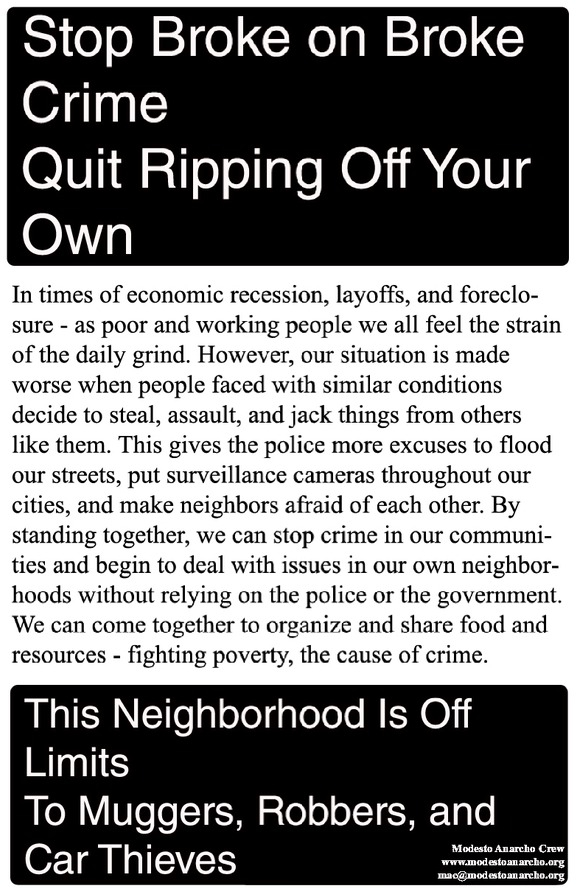
One clear way to avoid or frustrate the mechanisms of predictive policing is to follow the good ol' criminal adage--Don't shit where you eat. By taking crime out of the neighborhoods where we live, perhaps we can lessen the pressure on those places. One study of predictive policing found a correlation with the number of housing code violations in a neighborhood and the amount of burglary. Basically, people were burglarizing poor neighborhoods, which rationalized a police presence in those places. By decreasing "broke-on-broke crime" [http://www.indybay.org/uploads/2010/12/15/newposterbroke.pdf_600_.jpg], we are also fighting an increase of police patrols. For an interesting primer on how rich people defend against burglary, we here at SCR would recommend Jack MacLean's Secrets of a Superthief [http://www.scribd.com/doc/59565220/Jack-maclean-secrets-of-a-superthief]. He robbed exclusively from rich neighborhoods and did it with mad style.
Beyond doing crime intelligently, we also have the capacity to disrupt the community aspects of policing. While there are infinite possibilities for this, here are three interesting departure points for you and your crew. The friendly face of community policing is sugary icing on a cake of shit. It's important to show the entire idea of "policing" as rotten at its core and to fight police attempts to insert themselves into neighborhood dialogue.
First, the local example. On March 13th, about 60 folks got together at Grant St. Park to barbecue "for a world without police." There was a free wall for graffiti, dank grub, and an awesome Know Your Rights workshop [http://www.indybay.org/newsitems/2011/03/13/18674483.php]. By initiating conversations in the places we live, we can clarify our own position and make friends with our neighbors who feel similarly.
Secondly, we can disrupt the police department's attempts to legitimize itself. In Modesto, comrades staged a disruption [http://www.modestoanarcho.org/2010/12/masked-protesters-disrupt-police.html] of a police accreditation meeting. At a time when the MPD was attempting to pat itself on the back, people made sure everyone remembered that the MPD were murderers.
Lastly, comrades in Vancouver, BC, took space back from Community Policing efforts with a concerted vandalism campaign [http://confrontation.wordpress.com/2009/02/11/vandals-threaten-future-of-vancouverpolicing-centre/]. Eventually, the community policing center was forced to relocate. Community police forces can often act as the vanguard of gentrification, making a place more digestible to yuppies. Here is one of many ways that activity directed against the police intersects with other struggles.
Obviously, different forms of resistance are applicable to different contexts. Santa Cruz is the pilot city for a program that has the potential to change the shape of modern policing. With our shoulder to the wheel, let's make it a failure.
[http://surfcityrevolt.blogspot.com/2011/07/new-era-in-policing.html]
News of "Predictive Policing" first surfaced around the new year. Hailed as the next generation of policing, it seeks to direct police resources to "times and places" where there is a greater likelihood of crime being committed. Sometime in January, the Santa Cruz Police Department finished submitting crime reports from the last eight years to George Mohler [http://math.scu.edu/~gmohler/homepage.html], a mathematics professor at Santa Clara University. Santa Cruz is the first city in the nation to embrace this model. In Mohler's own words: "The more you put police in areas where there is more crime, the more efficiently you're policing the city." The Sentinel article about SCPD's adoption of the program can be found here [http://www.santacruzsentinel.com/ci_17105195]. In this article, rather than rehashing what has already been said, we will emphasize the unstated significance of predictive policing and point towards ways to frustrate, antagonize, or just operate within a town that will try to predict your crime before you commit it.
New Smell, Same Shit -
Since at least some future police reports will be a product of predictive policing, while the analytics that power predictive policing are fed by prior police reports, it is likely that the predictive policing will create reinforcing feedback loops [http://en.wikipedia.org/wiki/Positive_feedback]. As predictive policing recognizes a concentration of criminal activity, it will direct police resources towards that concentration. The concentration can be geographical, like the Bonesio's Parking Lot, and also have a temporal dimension, like closing time. By directing police patrols towards these locations, the police can harass, detain, or arrest people more efficiently. Their actions result in police reports that get funneled back into the predictive policing analytics, further concentrating crime in these already targeted areas.
By targeting places where crime is already reported, predictive policing increases social division: bad neighborhoods are further ghettoized, while pressure it taken off good neighborhoods. Kids in the upper westside take "d-methamphetamine" (marketed as Deoxsyn for ADHD) to get high and feel good, while those trapped in desperate circumstances smoke dirty crystal for the same reasons. One group is mostly ignored by police, while the other is criminalized. Predictive policing further concentrates police pressure on the more targeted group. This is not to say that the ideal solution is some equitable form of policing, only that existing social divisions are further sharpened by this program.
At least some of the inspiration for predictive policing comes from the success of computer analytics in determining the actions of consumers. As Police Chief Magazine reports [http://www.policechiefmagazine.org/magazine/index.cfm?fuseaction=display_arch&article_id=1942&issue_id=112009]:
[begin excerpt]
Advanced analytics are used in almost every segment of society to improve service and optimize resources. Some examples include customer loyalty programs that track purchases and provide specifically targeted coupons that are based on recent or related purchases and algorithms that create models of customer preferences and recommend products to similar customer groups.
[end excerpt]
In every corner of our lives, data is being collected about us and our actions. These data storehouses have been utilized to sell us consumer goods tailored to our specific tastes. Now, these databases are becoming fodder for the predictive policing analytics. In a Department of Justice bulletin on Community-Oriented Policing [http://www.nij.gov/nij/maps/gps-bulletin-v2i4.pdf], the first "tool" listed in a "predictive policing toolbox" was to: "Identify data from other agencies (e.g., schools and hospitals) that may be useful for predictive policing analyses". Predictive Policing might be the bridge between the warehousing of personal and relational data and the always-tightening clampdown of social control. Advanced analytics, of course, have always been part of the police toolkit, but until now they have been reserved for large operations, usually run by federal agencies. Now, the same techniques are becoming available at local levels.
As these techniques trickle down to local agencies, coupled with Jerry Brown's restructuring towards local government, police are realizing that "community" initiatives are of increasing importance. If the police are going to be on your block constantly, they want to do it with a smiling face. Put differently, they want to avoid being a target for the antagonism they deserve.
Defenders of predictive policing say that it doesn't target individuals, only locations. But you'd be blind if you couldn't see that different areas are defined by the presence of different social groups. For instance, one distinct group of people hangs out on the Pasatiempo Golf Course while another hangs out outside the laundromat on Barson St. This new advance in policing is only a new excuse to do what police have always done: reinforce class divisions and quarantine "undesirable" social groups.
Responding to Predictive Policing -
One clear way to avoid or frustrate the mechanisms of predictive policing is to follow the good ol' criminal adage--Don't shit where you eat. By taking crime out of the neighborhoods where we live, perhaps we can lessen the pressure on those places. One study of predictive policing found a correlation with the number of housing code violations in a neighborhood and the amount of burglary. Basically, people were burglarizing poor neighborhoods, which rationalized a police presence in those places. By decreasing "broke-on-broke crime" [http://www.indybay.org/uploads/2010/12/15/newposterbroke.pdf_600_.jpg], we are also fighting an increase of police patrols. For an interesting primer on how rich people defend against burglary, we here at SCR would recommend Jack MacLean's Secrets of a Superthief [http://www.scribd.com/doc/59565220/Jack-maclean-secrets-of-a-superthief]. He robbed exclusively from rich neighborhoods and did it with mad style.
Beyond doing crime intelligently, we also have the capacity to disrupt the community aspects of policing. While there are infinite possibilities for this, here are three interesting departure points for you and your crew. The friendly face of community policing is sugary icing on a cake of shit. It's important to show the entire idea of "policing" as rotten at its core and to fight police attempts to insert themselves into neighborhood dialogue.
First, the local example. On March 13th, about 60 folks got together at Grant St. Park to barbecue "for a world without police." There was a free wall for graffiti, dank grub, and an awesome Know Your Rights workshop [http://www.indybay.org/newsitems/2011/03/13/18674483.php]. By initiating conversations in the places we live, we can clarify our own position and make friends with our neighbors who feel similarly.
Secondly, we can disrupt the police department's attempts to legitimize itself. In Modesto, comrades staged a disruption [http://www.modestoanarcho.org/2010/12/masked-protesters-disrupt-police.html] of a police accreditation meeting. At a time when the MPD was attempting to pat itself on the back, people made sure everyone remembered that the MPD were murderers.
Lastly, comrades in Vancouver, BC, took space back from Community Policing efforts with a concerted vandalism campaign [http://confrontation.wordpress.com/2009/02/11/vandals-threaten-future-of-vancouverpolicing-centre/]. Eventually, the community policing center was forced to relocate. Community police forces can often act as the vanguard of gentrification, making a place more digestible to yuppies. Here is one of many ways that activity directed against the police intersects with other struggles.
Obviously, different forms of resistance are applicable to different contexts. Santa Cruz is the pilot city for a program that has the potential to change the shape of modern policing. With our shoulder to the wheel, let's make it a failure.
2011-07-16 "Man shot by SFPD dies from injuries"
[http://abclocal.go.com/kgo/story?section=news%2Flocal%2Fsan_francisco&id=8254726]
SAN FRANCISCO (KGO) -- A man shot by police in the Bayview District Saturday afternoon has died from his injuries.
The shooting happened near the intersection of Third and Oakdale Streets in San Francisco around 4:40 p.m. Saturday.
Eyewitensses told ABC7 News the suspect, identified only as a 19-year-old man, de-boarded the T-Third Muni train without a ticket. When he was approached by police, the suspect fled and at one poitn was shot at several times by police, according to witnesses.
The suspect was rushed to San Francisco General Hospital. He was pronounced dead shortly after 7:00 p.m.
There's no word on what caused officers to open fire on the suspect. No other injuries were reported.
Portions of Third Street between Oakdale and Palau were briefly closed during the police investigation. Tactical police officers were called out to keep watch over a large crowd of onlookers in the minutes after the shooting.
2011-07-16 "Police shoot individual in Bayview" by Dan Schreiber
[http://www.sfexaminer.com/local/2011/07/police-shoot-individual-bayview]
San Francisco police have shot a person in the Bayview district Saturday afternoon in what may be The City's second transit-related shooting in two weeks.
The shooting occurred about 4:30 p.m. near the Muni stop at Third Street and Oakdale Avenue. KGO (Ch. 7) reported that a man was shot at six to 10 times after getting off a T-Third Street light-rail train. The man did not have a valid fare and was running away from the train when shot to avoid paying a fine.
About three dozen police in riot gear were on the scene, with members of the neighborhood visibly upset. People who gathered at the Muni stop were throwing bottles at police, who had three blocks of Third Street blocked off, from Palou to Newcomb avenues.
The Fire Department was also on the scene and had a ladder going to the rooftop of a nearby building, possibly to search for a discarded weapon, according to police and fire officials.
On July 3, BART police officers shot and killed Charles Hill, who allegedly was drunk and wielding a broken bottle and one or two knives on the platform at the Civic Center station.
[http://abclocal.go.com/kgo/story?section=news%2Flocal%2Fsan_francisco&id=8254726]
SAN FRANCISCO (KGO) -- A man shot by police in the Bayview District Saturday afternoon has died from his injuries.
The shooting happened near the intersection of Third and Oakdale Streets in San Francisco around 4:40 p.m. Saturday.
Eyewitensses told ABC7 News the suspect, identified only as a 19-year-old man, de-boarded the T-Third Muni train without a ticket. When he was approached by police, the suspect fled and at one poitn was shot at several times by police, according to witnesses.
The suspect was rushed to San Francisco General Hospital. He was pronounced dead shortly after 7:00 p.m.
There's no word on what caused officers to open fire on the suspect. No other injuries were reported.
Portions of Third Street between Oakdale and Palau were briefly closed during the police investigation. Tactical police officers were called out to keep watch over a large crowd of onlookers in the minutes after the shooting.
2011-07-16 "Police shoot individual in Bayview" by Dan Schreiber
[http://www.sfexaminer.com/local/2011/07/police-shoot-individual-bayview]
San Francisco police have shot a person in the Bayview district Saturday afternoon in what may be The City's second transit-related shooting in two weeks.
The shooting occurred about 4:30 p.m. near the Muni stop at Third Street and Oakdale Avenue. KGO (Ch. 7) reported that a man was shot at six to 10 times after getting off a T-Third Street light-rail train. The man did not have a valid fare and was running away from the train when shot to avoid paying a fine.
About three dozen police in riot gear were on the scene, with members of the neighborhood visibly upset. People who gathered at the Muni stop were throwing bottles at police, who had three blocks of Third Street blocked off, from Palou to Newcomb avenues.
The Fire Department was also on the scene and had a ladder going to the rooftop of a nearby building, possibly to search for a discarded weapon, according to police and fire officials.
On July 3, BART police officers shot and killed Charles Hill, who allegedly was drunk and wielding a broken bottle and one or two knives on the platform at the Civic Center station.
Monday, July 11, 2011
2011-07-11 Civil Rights protest at BART in honor of police murder victim Charles Hill
In this image from July 11, a protester denounces the BART police shooting of Charles Hill, pictured. Photo by Luke Thomas, fogcityjournal.com


Subscribe to:
Posts (Atom)