2011-07-16 "A New Era in Policing?"
[http://surfcityrevolt.blogspot.com/2011/07/new-era-in-policing.html]
News of "Predictive Policing" first surfaced around the new year. Hailed as the next generation of policing, it seeks to direct police resources to "times and places" where there is a greater likelihood of crime being committed. Sometime in January, the Santa Cruz Police Department finished submitting crime reports from the last eight years to George Mohler [http://math.scu.edu/~gmohler/homepage.html], a mathematics professor at Santa Clara University. Santa Cruz is the first city in the nation to embrace this model. In Mohler's own words: "The more you put police in areas where there is more crime, the more efficiently you're policing the city." The Sentinel article about SCPD's adoption of the program can be found here [http://www.santacruzsentinel.com/ci_17105195]. In this article, rather than rehashing what has already been said, we will emphasize the unstated significance of predictive policing and point towards ways to frustrate, antagonize, or just operate within a town that will try to predict your crime before you commit it.
New Smell, Same Shit -
Since at least some future police reports will be a product of predictive policing, while the analytics that power predictive policing are fed by prior police reports, it is likely that the predictive policing will create reinforcing feedback loops [http://en.wikipedia.org/wiki/Positive_feedback]. As predictive policing recognizes a concentration of criminal activity, it will direct police resources towards that concentration. The concentration can be geographical, like the Bonesio's Parking Lot, and also have a temporal dimension, like closing time. By directing police patrols towards these locations, the police can harass, detain, or arrest people more efficiently. Their actions result in police reports that get funneled back into the predictive policing analytics, further concentrating crime in these already targeted areas.
By targeting places where crime is already reported, predictive policing increases social division: bad neighborhoods are further ghettoized, while pressure it taken off good neighborhoods. Kids in the upper westside take "d-methamphetamine" (marketed as Deoxsyn for ADHD) to get high and feel good, while those trapped in desperate circumstances smoke dirty crystal for the same reasons. One group is mostly ignored by police, while the other is criminalized. Predictive policing further concentrates police pressure on the more targeted group. This is not to say that the ideal solution is some equitable form of policing, only that existing social divisions are further sharpened by this program.
At least some of the inspiration for predictive policing comes from the success of computer analytics in determining the actions of consumers. As Police Chief Magazine reports [http://www.policechiefmagazine.org/magazine/index.cfm?fuseaction=display_arch&article_id=1942&issue_id=112009]:
[begin excerpt]
Advanced analytics are used in almost every segment of society to improve service and optimize resources. Some examples include customer loyalty programs that track purchases and provide specifically targeted coupons that are based on recent or related purchases and algorithms that create models of customer preferences and recommend products to similar customer groups.
[end excerpt]
In every corner of our lives, data is being collected about us and our actions. These data storehouses have been utilized to sell us consumer goods tailored to our specific tastes. Now, these databases are becoming fodder for the predictive policing analytics. In a Department of Justice bulletin on Community-Oriented Policing [http://www.nij.gov/nij/maps/gps-bulletin-v2i4.pdf], the first "tool" listed in a "predictive policing toolbox" was to: "Identify data from other agencies (e.g., schools and hospitals) that may be useful for predictive policing analyses". Predictive Policing might be the bridge between the warehousing of personal and relational data and the always-tightening clampdown of social control. Advanced analytics, of course, have always been part of the police toolkit, but until now they have been reserved for large operations, usually run by federal agencies. Now, the same techniques are becoming available at local levels.
As these techniques trickle down to local agencies, coupled with Jerry Brown's restructuring towards local government, police are realizing that "community" initiatives are of increasing importance. If the police are going to be on your block constantly, they want to do it with a smiling face. Put differently, they want to avoid being a target for the antagonism they deserve.
Defenders of predictive policing say that it doesn't target individuals, only locations. But you'd be blind if you couldn't see that different areas are defined by the presence of different social groups. For instance, one distinct group of people hangs out on the Pasatiempo Golf Course while another hangs out outside the laundromat on Barson St. This new advance in policing is only a new excuse to do what police have always done: reinforce class divisions and quarantine "undesirable" social groups.
Responding to Predictive Policing -
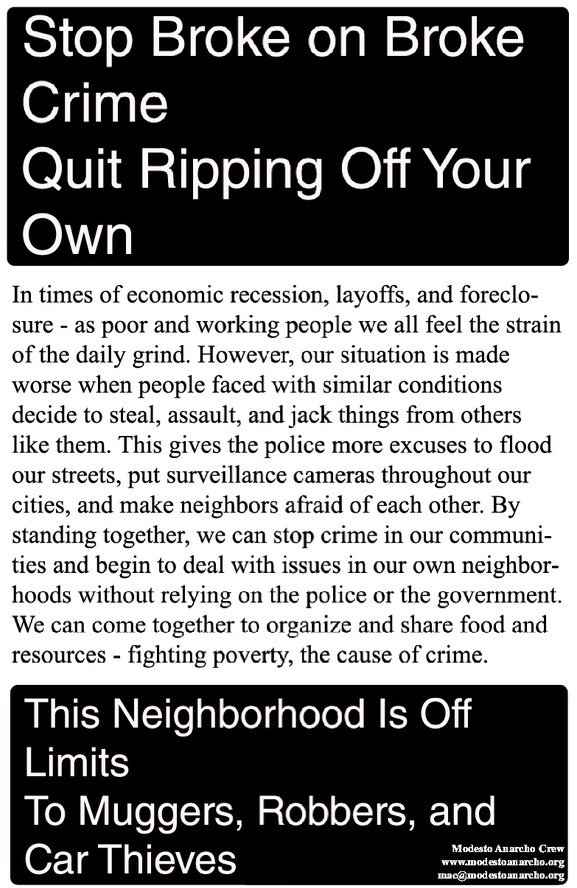
One clear way to avoid or frustrate the mechanisms of predictive policing is to follow the good ol' criminal adage--Don't shit where you eat. By taking crime out of the neighborhoods where we live, perhaps we can lessen the pressure on those places. One study of predictive policing found a correlation with the number of housing code violations in a neighborhood and the amount of burglary. Basically, people were burglarizing poor neighborhoods, which rationalized a police presence in those places. By decreasing "broke-on-broke crime" [http://www.indybay.org/uploads/2010/12/15/newposterbroke.pdf_600_.jpg], we are also fighting an increase of police patrols. For an interesting primer on how rich people defend against burglary, we here at SCR would recommend Jack MacLean's Secrets of a Superthief [http://www.scribd.com/doc/59565220/Jack-maclean-secrets-of-a-superthief]. He robbed exclusively from rich neighborhoods and did it with mad style.
Beyond doing crime intelligently, we also have the capacity to disrupt the community aspects of policing. While there are infinite possibilities for this, here are three interesting departure points for you and your crew. The friendly face of community policing is sugary icing on a cake of shit. It's important to show the entire idea of "policing" as rotten at its core and to fight police attempts to insert themselves into neighborhood dialogue.
First, the local example. On March 13th, about 60 folks got together at Grant St. Park to barbecue "for a world without police." There was a free wall for graffiti, dank grub, and an awesome Know Your Rights workshop [http://www.indybay.org/newsitems/2011/03/13/18674483.php]. By initiating conversations in the places we live, we can clarify our own position and make friends with our neighbors who feel similarly.
Secondly, we can disrupt the police department's attempts to legitimize itself. In Modesto, comrades staged a disruption [http://www.modestoanarcho.org/2010/12/masked-protesters-disrupt-police.html] of a police accreditation meeting. At a time when the MPD was attempting to pat itself on the back, people made sure everyone remembered that the MPD were murderers.
Lastly, comrades in Vancouver, BC, took space back from Community Policing efforts with a concerted vandalism campaign [http://confrontation.wordpress.com/2009/02/11/vandals-threaten-future-of-vancouverpolicing-centre/]. Eventually, the community policing center was forced to relocate. Community police forces can often act as the vanguard of gentrification, making a place more digestible to yuppies. Here is one of many ways that activity directed against the police intersects with other struggles.
Obviously, different forms of resistance are applicable to different contexts. Santa Cruz is the pilot city for a program that has the potential to change the shape of modern policing. With our shoulder to the wheel, let's make it a failure.
Saturday, July 16, 2011

2011-07-16 "Man shot by SFPD dies from injuries"
[http://abclocal.go.com/kgo/story?section=news%2Flocal%2Fsan_francisco&id=8254726]
SAN FRANCISCO (KGO) -- A man shot by police in the Bayview District Saturday afternoon has died from his injuries.
The shooting happened near the intersection of Third and Oakdale Streets in San Francisco around 4:40 p.m. Saturday.
Eyewitensses told ABC7 News the suspect, identified only as a 19-year-old man, de-boarded the T-Third Muni train without a ticket. When he was approached by police, the suspect fled and at one poitn was shot at several times by police, according to witnesses.
The suspect was rushed to San Francisco General Hospital. He was pronounced dead shortly after 7:00 p.m.
There's no word on what caused officers to open fire on the suspect. No other injuries were reported.
Portions of Third Street between Oakdale and Palau were briefly closed during the police investigation. Tactical police officers were called out to keep watch over a large crowd of onlookers in the minutes after the shooting.
2011-07-16 "Police shoot individual in Bayview" by Dan Schreiber
[http://www.sfexaminer.com/local/2011/07/police-shoot-individual-bayview]
San Francisco police have shot a person in the Bayview district Saturday afternoon in what may be The City's second transit-related shooting in two weeks.
The shooting occurred about 4:30 p.m. near the Muni stop at Third Street and Oakdale Avenue. KGO (Ch. 7) reported that a man was shot at six to 10 times after getting off a T-Third Street light-rail train. The man did not have a valid fare and was running away from the train when shot to avoid paying a fine.
About three dozen police in riot gear were on the scene, with members of the neighborhood visibly upset. People who gathered at the Muni stop were throwing bottles at police, who had three blocks of Third Street blocked off, from Palou to Newcomb avenues.
The Fire Department was also on the scene and had a ladder going to the rooftop of a nearby building, possibly to search for a discarded weapon, according to police and fire officials.
On July 3, BART police officers shot and killed Charles Hill, who allegedly was drunk and wielding a broken bottle and one or two knives on the platform at the Civic Center station.
Monday, July 11, 2011
2011-07-11 Civil Rights protest at BART in honor of police murder victim Charles Hill
In this image from July 11, a protester denounces the BART police shooting of Charles Hill, pictured. Photo by Luke Thomas, fogcityjournal.com


Wednesday, July 6, 2011
2011-07-06 "Armed Citizens Confront Nazi Checkpoint" by Sov3rgn Fr33man
[http://www.indybay.org/newsitems/2011/07/06/18683997.php]
Armed Bay Area residents confronted a nazi "show me your papers" checkpoint in Livermore, California on 4th of July weekend.
Police Departments use checkpoints to perform warrantless searches and steal vehicles from undocumented drivers. Based on their own statistics, the Livermore PD subjected 1200 drivers to unreasonable searches and only arrested TWO drunk drivers at this checkpoint. That means less than 0.17% of those asked "show me your papers" were drinking! Since 11 vehicles were towed, we can conclude that 82% of the vehicles were stolen from undocumented drivers or people with registration issues.
We all know the real reason they have these checkpoints. The cities and law enforcement agencies make MILLIONS ($40 million across CA in 2009) from these fascist checkpoints.
Organize against checkpoints in your area!
Join Abolish Checkpoints: http://www.facebook.com/AbolishCheckpoints
Sunday, June 26, 2011
2011-06-26 "Homelessness in California is now punishable by a year in jail. Free Gary Johnson!" by Steven Argue [steveargue2 [at] yahoo.com] from "Liberation News"
[https://lists.riseup.net/www/info/liberation_news]
For protesting on the county steps against Santa Cruz laws that make it illegal for the homeless to sleep at night, homeless activists Gary Johnson (no relation to Becky Johnson) and Attorney Ed Frey were sentenced to 6 months in jail on June 10th. Bail was set for Ed Frey, pending appeal, at $50,000. Their only act of civil disobedience was sleeping. This occurred at their three month protest called “Peace Camp 2010”. Revealing the political nature of the draconian sentences, Judge Gallagher told homeless activist Gary Johnson that he “could get some sleep in jail” before they were dragged away in chains for their 6 month sentences. The law they were protesting makes it illegal for the homeless to sleep at night, outside or in a vehicle.
On Friday, June 24, after two weeks in jail, Ed Frey was released on bail pending appeal with his bail of $50,000 dollars reduced to $110. Supporters quickly passed the hat and Ed Frey was released from jail on bail. Gary Johnson still sits in jail.
Also convicted for sleeping at the protest were Arthur Bishoff and Collette Connolly. A fifth protester, Christopher Doyon didn’t show up for the kangaroo court trial and bench warrant was issued. A sixth protester, Eliot Anderson was freed by a hung jury that failed to convict him. A juror said of the case, Anderson should not have to gas his dog to try to get into a shelter to legally sleep.
Many potential jurors were upset by the fact that they were to sit through a two week trial for the “crime” of sleep. One example was an elementary school teacher who said, "When I first came to Santa Cruz, I lived in my van for three years. During that time, I was hassled, arrested, and jailed. There is no way I could be impartial in this case considering the pain these people are suffering." A number of potential jurors said such things, but of course they never made it on to the jury. People who are aware of what is going on generally don’t make it onto juries in the United States. Those less aware people who made it onto the jury were told, in a typical manner, that they weren’t allowed to have their own opinions. In the oft repeated mantra of blind stupidity and injustice in America’s capitalist courts, Judge Gallagher told the jury, "Even if you disagree with the law, you must follow the law."
The four protesters were convicted of state anti-lodging law 647(E) for sleeping at the protest. Arthur Bishoff and Collette Connolly did not show up for the absurdity of sentencing and warrants were issued. Ed Frey and Gary Johnson were offered 400 hours of Community Service and 3 years probation for sleeping. In response, Gary Johnson, homeless, asked, "How can I take probation to obey all laws, when you've defined "sleeping" as lodging to the jury, making it a misdemeanor crime? How can I not sleep for six months during probation?" On basic principle and inability to comply, both Gary Johnson and Attorney Ed Frey turned down probation.
This was reminiscent of an earlier Santa Cruz case where Sandy Loranger did time in jail for feeding the homeless soup. When the judge offered her counseling instead of jail Sandy Loranger replied, "If feeding my fellow people is a crime, I am beyond rehabilitation."
The protest Gary Johnson, Ed Frey, Arthur Bishoff, and Collette Connolly were prosecuted for was peaceful in nature with the only act of civil disobedience being the illegal act of sleep outside. Basic protest facilities were included with Attorney Ed Frey providing the protesters with a needed port-a-potty. This helped provide the homeless with a safe place to sleep for months, despite the city government’s failure to provide such needed relief for its citizens.
The protest also shamed the city government into modifying the city’s law that makes it illegal for the homeless to sleep at night by providing a dismissal of the charges in court if the homeless being charged with sleep can show that they were on the waiting list for the insufficient shelter provided at the Homeless Service Center at the time they were ticketed. Other protests in the 1990s shamed the Santa Cruz City government into reducing the fine for sleeping at night outside or in a vehicle, but the Santa Cruz City Council continued to keep sleep at night for the homeless illegal at that time as well.
During those protests in the 1990s activists were arrested and brutalized by the infamously repressive Santa Cruz Police. Activist B.D. was tackled off his soap box and pepper sprayed by the Santa Cruz Police for giving a speech in favor of the homeless in front of numerous eyewitnesses and a video camera. In 1998 this author was beaten and arrested, spending four days in jail, for exercising my First Amendment right to distribute literature. It was literature in favor of rights for the homeless and opposed to police brutality.
The law for which Gary Johnson and Ed Frey were arrested, prosecuted, convicted, and sentenced was Penal Code Section 647(E), for “unlawful lodging”. This is a California state law. It was also recently used in August 2010 by the Santa Barbara Police to ticket Courtney Caswell-Peyton, a Santa Barbara disabled woman who fell asleep in her wheel chair. She showed-up for court worried about the possibility of getting her first conviction for any crime. Facing strong protest in that case, the Santa Barbara DA dismissed the charge in the “interests of justice”. While happy about not being convicted, she left court saying she was still homeless and questioning why she had no place to sleep.
Unlike the Santa Barbara dismissal, Gary Johnson, Ed Frey, Arthur Bishoff, and Collette Connolly were convicted in the notoriously bad Santa Cruz courts. Judge Gallagher is making an example of them for standing-up against the anti-homeless laws of Santa Cruz. The suspected reason cops charged the four with the state law rather than the Santa Cruz anti-sleeping law was a loophole where city laws didn’t apply because the protest was on county property. But, as a cop once told this author, “this is Santa Cruz; we can find a law for anything”. And find a law they did.
In 1983 the U.S. Supreme Court ruled that an earlier version of Penal Code Section 647(E) was unconstitutional in the case of Kolender v. Lawson. It was an anti-vagrancy law that was brought to the supreme court after it was used by San Diego Police to repeatedly harass a Black man with dread locks who was committing no real crime. As a result of that Supreme Court ruling that version of Penal Code Section 647(E) was repealed by the state legislature in 2008.
Since the overturning of the original 647(E) a new version was passed by the State Legislature which states, “Who lodges in any building, structure, vehicle, or place, whether public or private, without the permission of the owner or person entitled to the possession or in control of it” “are guilty of disorderly conduct, a misdemeanor". Lodging is being used as a euphemism for sleeping here. This is the law the four protesters were convicted under.
In May 2011, this anti-homeless law 647 (E) was made even worse with the State Legislature making a second violation punishable of up to a year in jail and $2,000 fine. So now homelessness in the state of California is punishable by up to a year in jail if one is caught doing it twice.
Voting for this worsened anti-homeless law were Democrats and Republicans alike, including local Santa Cruz Democrat and darling of many reformist liberals, Bill Monning. Monning voted for that increased penalty at the same time that the people who actually stand-up for human rights were fighting the constitutionality of the law in court with their freedom on the line.
Here is a full list of those who voted for the worsened anti-homeless law: Achadjian, Allen, Ammiano, Atkins, Beall, Beth Gaines, Bill Berryhill, Block, Blumenfield, Bonilla, Bradford, Brownley, Buchanan, Butler, Campos, Carter, Charles Calderon, Chesbro, Cook, Davis, Dickinson, Donnelly, Eng, Feuer, Fletcher, Fong, Fuentes, Furutani, Galgiani, Gatto, Gordon, Grove, Hagman, Halderman, Hall, Harkey, Hayashi, Hill, Huber, Hueso, Huffman, Jeffries, John A. Pérez, Jones, Knight, Lara, Logue, Ma, Mansoor, Mendoza, Miller, Monning, Morrell, Nestande, Nielsen, Norby, Olsen, Pan, Perea, Silva, Skinner, Smyth, Solorio, Swanson, V. Manuel Pérez, Valadao, Wagner, Wieckowski, Williams, and Yamada.
None voted against.
As the California state government, dominated by Democrats, passes anti-working class austerity and extremely harsh anti-homeless legislation, the Democrat holding power in Washington, Obama, wages wars in an increasing number of the world’s countries for the profit of arms manufacturers, oil corporations, and other imperialist capitalists and locks-up suspected whistle blower on U.S. crimes against humanity, Bradley Manning, under intolerable conditions. Bradley Manning is accused of releasing the helicopter footage that shows U.S. troops nonchalantly gunning down civilians including journalists, first aid respondents, and children in cold blood. Instead of charges of murder for those who committed it, it is Bradley Manning who goes to prison under Obama. Likewise, billions that could be used in a saner society for housing, healthcare, and education are squandered on war.
Meanwhile, the local Democrats in power in Santa Cruz send out their county and city cops to silence protests for human rights for the homeless, support legislation against immigrants like the “Secure Communities” program, and threaten to cut the already meager wages of In Home Support Workers, wages needed to provide the care that helps keep the disabled, elderly, and dying in their homes. While Santa Cruz Mayor Ryan Coonerty supports the city’s anti-homeless laws, police repression, and has signed on with the anti-immigrant “Secure Communities” program, he opposes measures that would help fight homelessness like an increase in the minimum wage and has been part of carrying out austerity that includes the lay-off of workers and cuts in homeless services while at the same time hiring more cops.
[ ... ]
Free Gary Johnson! Overturn the Convictions of Ed Frey, Arthur Bishoff, Collette Connolly! Hands Off Christopher Doyon! End Laws making it Illegal for the Homeless to Sleep at Night! Seize Housing From the Banks for those Who Need Housing! For a Nation Wide Jobs Program Building Housing for All!
2011-06-28 "Gary Johnson is Out on Bail!" from Steven Argue -
Forwarded message from Gary Johnson: "I JUST got out on bail (pending Appeal), from (eventually Minimum) Medium Security Jail in Watsonville (aka The Farm)."
2011-07-02 Update on the Case of Gary Johnson
Gary Johnson was released from jail earlier this week PENDING APPEAL, after over two weeks in jail. Like Attorney Ed Frey, he still faces the continuation of his 6 month in jail sentence for sleeping at the “Peace Camp 2010” protest against anti-sleeping laws.
This week the following motion in solidarity with the case was passed by the Oscar Grant Committee Against Police Brutality & State Repression regarding these cases and laws:
“The "Oscar Grant Committee, to Stop Police Brutality and State Repression" considers the Santa Cruz ordinance against "sleeping in public" to be UNJUST . particularly in the light of the ongoing housing crisis spreading across the country, where millions of people have been turned out of their homes do to the ongoing economic depression.
“We demand that all the charges against Homeless Rights Organizer Gary Johnson and others arrested, that occurred as a result of the peaceful non-violent homeless rights protest be dropped and any convictions overturned.
“We offer our solidarity and support to Gary Johnson and his supporters in the struggle for Human Rights and Dignity for the homeless.”
******* Send messages of support for Gary Johnson, Ed Frey, Arthur Bishoff, Collette Connolly, and Christopher Doyon and opposition to these laws to: steveargue2@yahoo.com
Wednesday, April 27, 2011
2011-04-27 "Attorney accuses Alameda County of racial profiling; Public defender was pulled over and searched in Castro Valley"
by Chris De Benedetti and Chris Metinko from "Oakland Tribune"
[http://www.contracostatimes.com/rss/ci_17943978?source=rss]:
OAKLAND -- A civil rights lawsuit filed by an African-American attorney claims a Castro Valley traffic stop made by Alameda County sheriff's deputies last year was a case of racial profiling.
The lawsuit, filed in U.S. District Court in Oakland this week, claims a deputy pulled Kwixuan Maloof over for dubious reasons, then unlawfully handcuffed and detained him while illegally searching his car.
Maloof is a managing felony attorney in the San Francisco Public Defender's Office, as well as president of the Charles Houston Bar Association -- the largest association of African-American lawyers in Northern California.
Maloof, 42, was driving his 2004 Cadillac XLR on March 5, 2010, when a deputy, who was white, pulled him over on East Castro Valley Boulevard, near Jensen Road. The suit claims the deputy told Maloof he pulled him over because he "heard a loud voice" from the car and that he had committed no traffic violation.
Maloof suspected he was being racially profiled and pulled out his cellphone camera. The filing says the deputy quickly blinded the camera with his flashlight. Other deputies arrived and confiscated Maloof's cellphone. He then was handcuffed and put in the back of a patrol car while officers searched the trunk of his car, according to the suit.
Maloof eventually was released, and no charges were filed.
"This incident happened over a year ago and every time I see the police, more specifically the sheriff's department, I get an uneasy feeling," said Maloof.
He said the incident frightened his family and embarrassed him.
"I feel I have to stand up for myself," said Maloof, who has been with the public defender's office for 10 years.
The lawsuit, which was filed Monday by Maloof's attorney John Burris, claims Maloof was unlawfully profiled, illegally detained, battered and suffered emotional distress. The suit also says the county has a pattern of "ongoing constitutional violations and unlawful practices constituting racial profiling" that the department's supervisors have done nothing to stop.
A sheriff's office spokesman said Sheriff Gregory Ahern had no comment.
"The sheriff was just recently provided this lawsuit, and he hasn't had a chance to review it, so he can't make a specific comment on the case," Sgt. J.D. Nelson said. "However, he does take great pride that all sheriff's employees do act in accordance with law and that they remain professional during difficult circumstances."
Alameda County Counsel also had no comment on the lawsuit.
Friday, April 15, 2011
2011-04-15 "Updated List of Stolen Lives with Latest In Custody Death at Sonoma County Jail"
On April 14th William Jackson, 59, died in the custody of the Sonoma County Sheriff Department. Mr. Jackson is the 42nd person to be killed by or die in the custody of law enforcement in Sonoma County since 2000. [http://pachline.org/?p=446]
The following and attached list is maintained by the Police Accountability Clinic and Helpline (www.pachline.org), please take a look at our site and consider donating to support our work.
THE SILENCE MUST END!
No more secrets. We demand timely, full disclosure of information in all police killings. These are the names of those who died at the hands of Sonoma County law enforcement, since a 1999 recommendation from the U.S. Civil Rights Commission Advisory Commission for a CIVILIAN REVIEW BOARD:
1. Philip Medina, 48, January 17, 2000 in custody Sonoma County Sheriff
2. James Curran, 51, March 19, 2000 in custody Sonoma County Sheriff
3. Erin Colleen McDonald, 31, April 20, 2000 shot five times Windsor Police* Fuston/Howard
4. Todd Eugene Dieterle, 37, May, 2000 shot seven times SRJC Police
5. Robert Comacho, 35, May 5, 2000 shot Rohnert Park Police
6. Patrick McLoughlin, 19, October 23, 2001 gunfire exchange Petaluma Police
7. Luis Solaro Gonzalez, 23, February 28, 2002 in custody Sonoma County Sheriff
8. Thomas John Connelly, 49, May 8, 2002 in custody Sonoma County Sheriff
9. Serena Roxanne Case, 32, January 16, 2003 in custody Sonoma County Sheriff
10. Keith Thompson Suite, 42, April 8, 2003 injured in custody Sonoma County Sheriff
11. Seth Micha Warde, 22, July 10, 2003 traffic stop CHP
12. Anthony Zakharoff, 49, July 27, 2003 in custody Sonoma County Sheriff
13. Michael W. Behringh, 52, November 18, 2003 in custody Sonoma County Sheriff
14. Joseph A. Peay, 35, September 18, 2004 shot 10 times Sheriff/CHP
15. Kenneth Hugh Duncan, 62, November 11, 2004 shot nine times Sonoma County Sheriff
16. April Hanlon 35, November 25, 2004 gunfire Sonoma County Sheriff
17. Terry Lee Grinner, Jr., 30, January 25, 2005 shot twice Rohnert Park Police
18. Carlos Casillas Fernandez, 31, July 16, 2005 tasered 6x Santa Rosa Police
19. James Anthony DeCosta, 72, October 1, 2005 shot 27 times Petaluma Police
20. James Richard Nace, 42, December 10, 2005 shot Sonoma County Sheriff
21. Moses McDowell, 29, November 6, 2006 in custody Sonoma County Sheriff
22. Haki Thurston, 22, February 23, 2007 shot 27 times Santa Rosa SWAT
23. Jeremiah Chass, 16, March 12, 2007 shot 8 times Sonoma County Sheriff
24. Richard DeSantis, 30, April 9, 2007 shot twice Santa Rosa Police
25. Walter L. Heller, 55, April 22, 2007 tasered twice Petaluma Police
26. Luis Felipe Sanchez, 27, May 4, 2007 shot 21 times Sonoma County Sheriff
27. Richard Lamont Williamson, 54, June 17, 2007 in custody Sonoma County Sheriff
28. Ryan George, 22, July 9, 2007 in custody Sonoma County Sheriff
29. William Townsley, 46, September 24, 2007 in custody Sonoma County Sheriff
30. James Marrufo, 48, December 1, 2007 in custody Sonoma County Sheriff
31. Jesse Hamilton, 24, January 2, 2008 shot Santa Rosa Police
32. Samuel Castillo-Martinez, 36, March 13, 2008 in custody Sonoma County Sheriff
33. Heather Smith-Billings, 31, March 16, 2008 shot Rohnert Park Police
34. Leonardo Pacheco, 39, April 21, 2008 in custody Sonoma County Sheriff
35. Guy James Fernandez, 52, November 9, 2008 stun gun Rohnert Park Police
36. Craig Von Dohlen 37, December 7, 2008 shot Sonoma County Sheriff
37. Nathan B Vaughn, 39, December 20, 2008 tasered 3x Sonoma County Sheriff
38. Jon Gerald Moore, 44, September 18, 2009 in custody Sonoma County Sheriff
39. Teresa Ellen Hagan, 49, January 21, 2010 in custody Sonoma County Sheriff
40. Albert Mike Leday, Jr, 49, June 1, 2010 shot 3x Sonoma County Sheriff *Fuston
41. Nicodemus Sullivan, 24, October 29, 2010 shot at 42 times Sheriff and CHP
42. William Jackson, 59, April 14, 2011 in custody Sonoma County Sheriff
Subscribe to:
Posts (Atom)